
Coal County Projected Versus Actual Release
Oklahoma Department of Corrections uses the formal term Projected Release Date, often shortened to PRD. It is an administrative estimate based on the controlling sentence and applicable credits. An actual release record proves an event that has already happened. It states when custody ended and may show whether the person discharged, entered parole, or transferred to another authority. An old PRD must never be substituted for that event record.
The distinction begins with custody status. A pretrial detainee has not yet received a final sentence from which a release date can be computed. Bond, dismissal, a release order, trial, a plea, and outside holds can each change the path. A person serving a county sentence may have a release calculation held by the Coal County Jail. A person committed to ODOC has a state calculation built from sentence and credit data.
A parole eligibility date is also different. Eligibility means the case can be considered for parole. It does not promise a favorable decision or physical release. The PRD estimates sentence-based release, while the Pardon and Parole Board process addresses conditional release. Each date should be named and sourced on its own.
Find a Coal County Projected Release
First identify whether the person remains at the county level or entered state custody. ODOC Offender Lookup covers ODOC offenders. It does not cover every person booked into the Coal County Jail. A short county stay that ends on bond may never create a state offender record. Search by ODOC number when possible, then compare the public identity and case data before relying on a result.
The ODOC Offender Info page is the durable official entry point. ODOC warns that a particular inmate’s exact release date is confidential unless legitimate need is shown. It also says the estimate is tentative and can change with earned-credit level, misconduct, or achievement credits. If the public result does not show a date, do not calculate and publish one from the sentence alone.
- Identify the holding system: Coal County Jail, ODOC, federal custody, or another authority.
- For ODOC, search by number or exact name and open the complete offender record.
- Read the status, sentence details, and any public date label exactly as displayed.
- For a county sentence, obtain the judgment from the Coal County court case and ask the jail records administrator for its calculation.
- For a pretrial case, check the court docket and bond or release orders instead of expecting a fixed PRD.
- Ask the record-holding agency to explain any mismatch between the judgment, jail credit, status, and date.
The official ODOC Offender Lookup screen shown below illustrates the correct state search route for a Coal County defendant who actually entered ODOC custody.
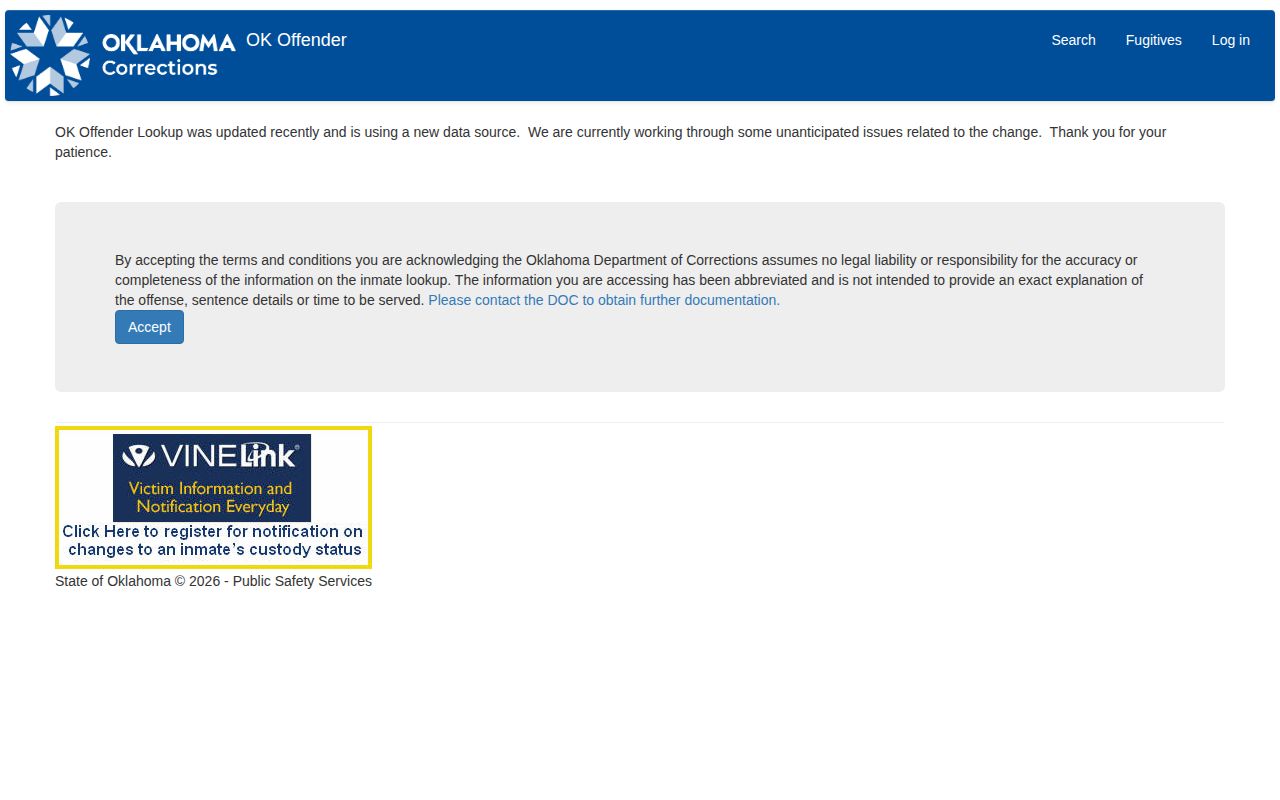
The state result must be read in context. A supervision location, prison facility, parole status, and discharge entry are not interchangeable, and a county-only detainee may not appear.
Note: A blank ODOC result can mean the Coal County person never entered state custody, so check the jail and court records next.
Coal County State Release Calculations
An ODOC PRD can reflect sentence start and reception information, verified jail credit, concurrent or consecutive sentence structure, earned-credit classification, achievement credits, lost credits, restoration of lost credits, statutory limits, and other release authority. The exact mix depends on the person’s offense date, conviction, sentence, and record. A sentence length standing alone does not yield a sound public countdown.
Oklahoma Title 57 §138 is the central earned-credit statute. The current statute should be read with ODOC policy OP-060211 because rates, eligibility, exclusions, and administration depend on the applicable rules. ODOC notes that §138(C) permits consideration of restoring credits removed for misconduct, nonperformance, or discipline, but restoration is not guaranteed. A person must meet the agency criteria.
The state’s formal paperwork matters because the PRD is a calculation, not a guess. The ODOC Section 06 forms and policies page links its earned-credit policy, sentence records policy, projected-release attachment, and correction route.
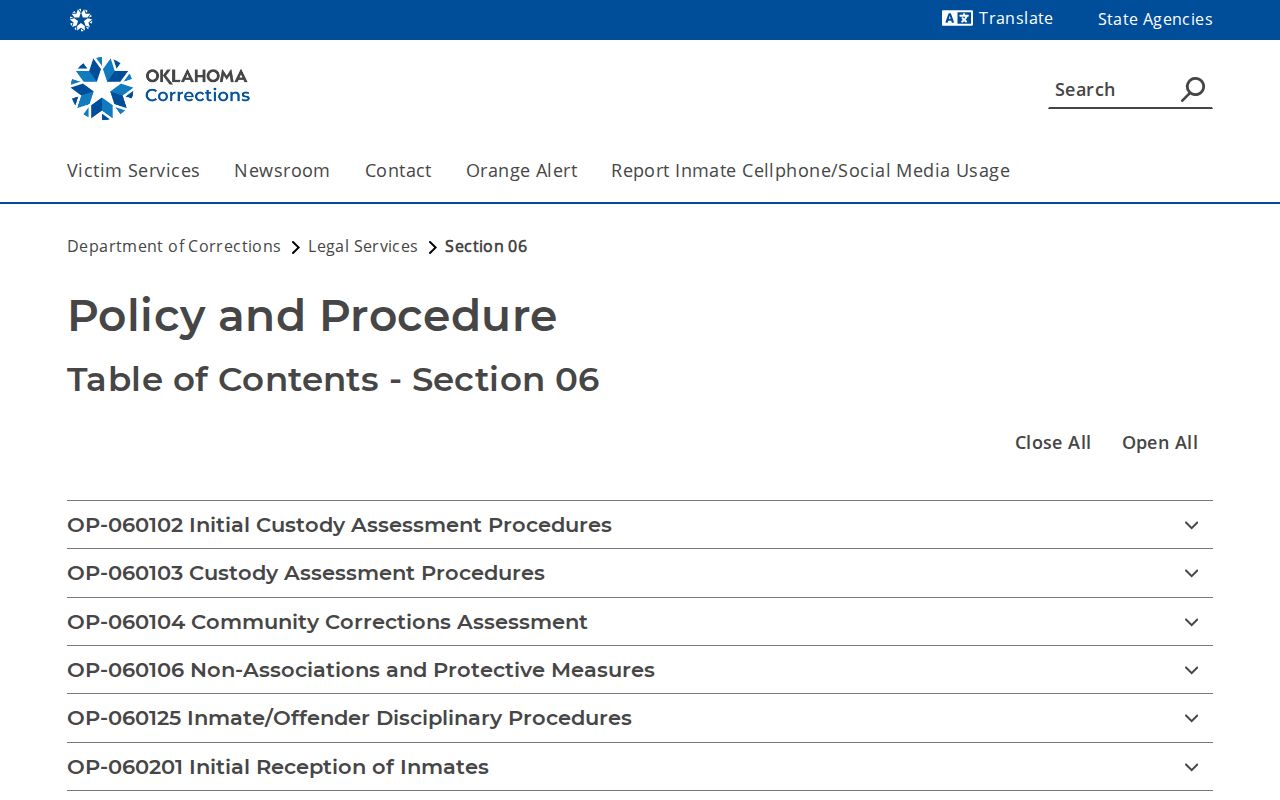
Those materials show why the calculation belongs with ODOC Sentence Administration and facility records staff, not with a copied calculator or an assumed percentage.
- Projected Release Date
- ODOC’s estimate of sentence-based release after applicable calculations.
- Jail credit
- Time in prior custody that is lawfully applied to the sentence.
- Concurrent sentences
- Sentences structured to run at the same time.
- Consecutive sentences
- Sentences structured to run one after another.
- Earned credit
- A sentence credit awarded and administered under applicable law and ODOC policy.
Coal County Release and 85 Percent
Oklahoma commonly calls the offenses listed in Title 21 §13.1 “85% crimes.” A person convicted of a listed offense must serve at least the required portion before parole eligibility and before credits can affect the mandatory part as the statute provides. The rule does not apply to every felony. The exact offense of conviction and offense date control.
The Oklahoma Pardon and Parole Board parole explanation summarizes the 85-percent requirement for violent crimes. Title 57 §332.7 governs initial parole consideration through multiple offense-date and offense-category rules and contains exclusions. Life without parole, for example, is outside ordinary parole eligibility. Current statutory text must be matched to the actual judgment rather than to an arrest label or a news summary.
A parole date and a PRD can move on separate tracks. Reaching parole eligibility means review may occur. It does not erase stipulations, detainers, a governor’s role where required, or the sentence calculation. Likewise, earned credit cannot be assumed to reduce a statutory floor. PPB and ODOC calculate the relevant dates from the official record.
Note: Never apply the 85-percent label from a charge alone; use the conviction, offense date, current statute, and official agency calculation.
Why Coal County Release Dates Move
A projected date changes when the facts or credits behind the calculation change. Some changes reward progress. Others reflect discipline, a corrected court record, another sentence, or a legal hold. The new estimate should be read from the official system, and the cause should be confirmed with the record custodian when it is not public.
| Factor | Possible effect on the projected release path | Best source |
|---|---|---|
| Corrected jail credit | Changes the time already credited to the sentence | Court order and ODOC Sentence Administration |
| Concurrent or consecutive structure | Changes the aggregate controlling term | Judgment and sentence records |
| Earned or achievement credits | May adjust the estimate within legal limits | ODOC credit record |
| Misconduct or nonperformance | May remove credits; restoration is discretionary | ODOC institutional record |
| Statutory minimum | Limits how credits affect mandatory service | Current statute and agency calculation |
| Parole action or detainer | May alter the route or prevent immediate community release | PPB, ODOC, and receiving authority |
| Amended judgment or data correction | Can change the display or controlling term | Court and ODOC records |
ODOC says an inmate receives the number of days remaining each month and may ask a facility records officer or case manager for help. That first-person channel can be more exact than a public display. Members of the public should not publish a homemade countdown as an official Coal County release date.
Coal County Jail Credit Is Separate
No official Coal County jail good-time policy was found in the research sweep. That absence is a key local fact. ODOC earned-credit classes cannot be copied onto a local jail sentence by analogy. A county sentence depends on the judgment, any court-ordered jail credit, Oklahoma law applicable to county prisoners, and the Sheriff’s lawful written practice.
Ask the Coal County Jail records administrator for the written policy and calculation sheet. Provide the full name, booking number, court case, and sentence date. If the projected county date differs from a plain reading of the judgment, request the credit calculation instead of guessing about time served. For a person who has already left, ask for the actual release timestamp and release reason.
The court file and jail calculation serve different roles. The judgment states the sentence imposed and may award credit for time already held. The jail administrator applies the lawful county rules to the custody record. A later court order can amend the term or credit. Compare the same case number and booking period across both records. If a figure remains unclear, ask which order, statute, or written policy produced it. That approach preserves the Coal County calculation without borrowing ODOC classifications that may not govern a county prisoner.
County custody can also end by transfer. A jail record may say the Sheriff released the person to ODOC, another county, a tribal authority, federal custody, or immigration custody. That is not the same as entering the community. Obtain the receiving agency when public, then continue the release-date check in that agency’s system.
Coal County Release Calculation Limits
Coal County has no published local good-time calculation located in the source sweep. ODOC, by contrast, names its estimate Projected Release Date and explains that earned-credit level, achievement credits, and misconduct can change it. Keeping those systems separate prevents a state formula from being presented as a county jail rule.
A current ODOC estimate also cannot prove a later event in advance. A detainer, court order, parole process, or data correction can change the path. The Sheriff’s release transaction controls a past Coal County jail release, while ODOC’s actual discharge or status record controls a state event. The source must match the custody that ended.
Confirm Coal County Actual Release
For an ODOC case, request public offender or discharge information through ODOC Legal Services. The agency lists osordischarges@doc.ok.gov for discharge-specific questions. For a county case, call the Coal County Sheriff at 580-927-2121 and ask for the booking-and-release entry, release timestamp, reason code with its definition, and receiving agency if the event was a transfer.
Automated custody notice can add a timely signal. The Coal County VINELink check explains how to register for a release or transfer event. Still, VINE is not a certified jail, court, or sentence record. Reconcile the alert with the agency that reported it.
The strongest final answer is precise: the agency, the date, the event, and any status that remained. “ODOC discharged the person” differs from “released to parole.” “Coal County custody ended by transfer” differs from a bond release. The Coal County released inmate search supplies the broader county record path. A projected date starts the inquiry, but the actual transaction completes it.